In today’s fast-paced business environment, managing employee attendance efficiently is essential for maintaining

 By mayur
June 08, 2026
By mayur
June 08, 2026
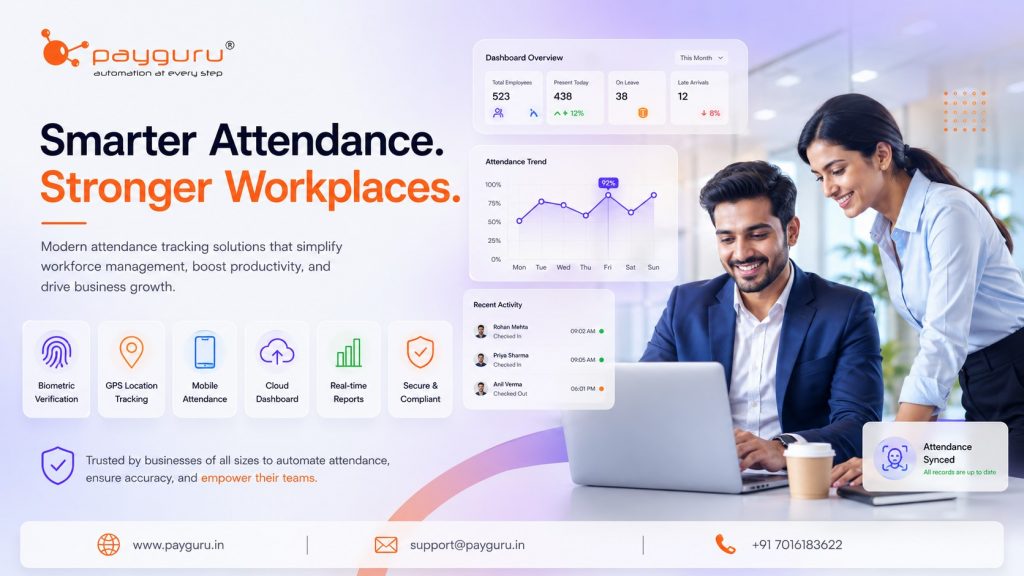
In today’s fast-paced business environment, managing employee attendance efficiently is essential for maintaining productivity, ensuring compliance, and streamlining workforce operations. Traditional attendance registers and manual spreadsheets are gradually being replaced by smarter, technology-driven solutions that offer greater accuracy and convenience.
Modern attendance tracking methods help organizations monitor employee working hours, reduce payroll errors, improve accountability, and support flexible work arrangements. Whether a company operates from a physical office, a hybrid workplace, or a remote environment, choosing the right attendance tracking system can significantly improve workforce management.
This article explores the best attendance tracking methods for modern offices and how businesses can select the most suitable approach for their needs.
Attendance management is more than simply recording when employees arrive and leave. It directly impacts:
A reliable attendance tracking system provides real-time visibility into workforce availability while reducing administrative burden on HR teams.
Many businesses still use manual attendance registers to record employee presence.
For growing organizations, manual attendance tracking often becomes inefficient and difficult to manage.
Biometric attendance systems have become one of the most popular attendance tracking methods in modern offices. These systems verify employee identity using unique biological characteristics.
Common biometric methods include:
Since biometric data is unique to every employee, attendance records are highly reliable.
Employees cannot mark attendance on behalf of others, reducing time theft and attendance fraud.
Modern biometric devices can authenticate employees within seconds, minimizing delays during office entry.
Attendance data can automatically sync with payroll and HR systems, reducing manual work.
Biometric attendance systems are particularly useful for organizations with large workforces and multiple shifts.
Radio Frequency Identification (RFID) technology uses employee ID cards or smart cards to record attendance.
Employees simply tap or scan their cards when entering or leaving the workplace.
Although RFID systems are more efficient than manual methods, they may not provide the same level of identity verification as biometric solutions.
With the rise of remote and hybrid work models, mobile attendance applications have become increasingly popular.
Employees can mark attendance directly from their smartphones.
Organizations with field staff, sales representatives, service technicians, and remote workers benefit significantly from mobile attendance solutions.
Employees can check in and check out without being physically present in the office, while managers maintain visibility into workforce activity.
GPS-enabled attendance systems add an additional layer of verification by confirming employee location during attendance marking.
Employers can verify whether employees are at approved work locations when marking attendance.
Sales teams, delivery personnel, and on-site service professionals can easily record attendance from different locations.
Managers gain visibility into workforce movement and location-based attendance records.
GPS attendance tracking is particularly valuable for organizations managing distributed teams or field operations.
Facial recognition technology has gained popularity due to its contactless and highly accurate attendance capabilities.
Using artificial intelligence and advanced image recognition, the system identifies employees through facial features.
Facial recognition systems became especially relevant as organizations prioritized hygiene and touch-free workplace technologies.
Cloud-based attendance solutions combine multiple attendance tracking methods within a centralized platform.
These systems can integrate:
HR teams and managers can monitor attendance data from any location with internet access.
Attendance records are instantly updated and available for analysis.
Cloud solutions support growing businesses without requiring major infrastructure investments.
Modern cloud platforms provide secure storage, backup, and controlled access to attendance records.
Cloud-based attendance management systems are increasingly becoming the preferred choice for businesses seeking flexibility and efficiency.
The modern workforce is no longer limited to a single office location. Many organizations now operate with hybrid work arrangements.
An effective hybrid attendance tracking solution should support:
Businesses that adopt integrated attendance management systems can maintain transparency while offering employees greater flexibility.
Selecting the best attendance tracking solution depends on several factors.
Small businesses may start with mobile or RFID-based systems, while larger organizations often benefit from biometric or cloud-based solutions.
Consider whether employees work:
Look for systems that integrate with:
Organizations handling sensitive operations may require advanced verification methods such as biometrics or facial recognition.
Choose a solution capable of supporting future workforce growth and changing business requirements.
Attendance management continues to evolve with advances in automation, artificial intelligence, and cloud technology.
Emerging trends include:
As organizations embrace digital transformation, attendance tracking systems will play an increasingly important role in workforce optimization and operational efficiency.
Modern attendance tracking methods offer far more than basic time recording. From biometric attendance systems and facial recognition technology to GPS-enabled mobile applications and cloud-based platforms, businesses now have access to powerful tools that improve accuracy, enhance accountability, and simplify workforce management.
Choosing the right attendance tracking solution depends on your organization’s size, work model, and operational requirements. Businesses that invest in modern attendance management systems can streamline HR processes, reduce administrative workload, and create a more efficient workplace environment.
If your organization is looking to improve workforce management, now is the time to evaluate modern attendance tracking solutions that support productivity, compliance, and business growth.