Human Resource Management Systems (HRMS) have evolved significantly over the past decade. What started as software for managing
 By Pay GURU
June 10, 2026
By Pay GURU
June 10, 2026
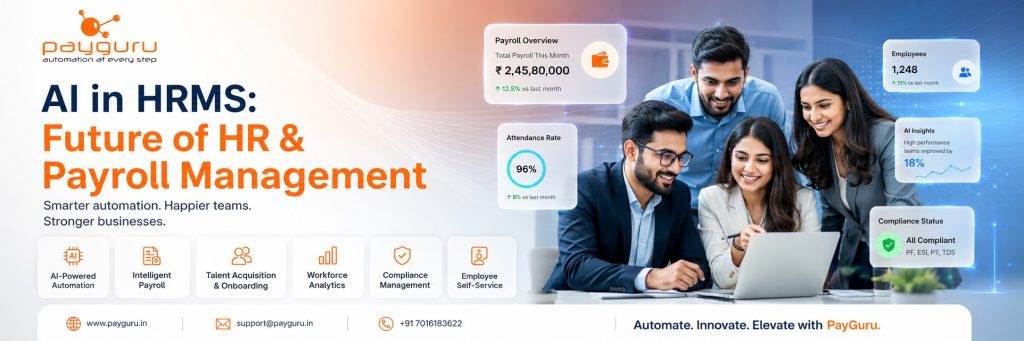
Human Resource Management Systems (HRMS) have evolved significantly over the past decade. What started as software for managing employee records and payroll has transformed into intelligent platforms that support workforce planning, employee engagement, compliance management, and business decision-making. Today, Artificial Intelligence (AI) is accelerating this transformation, helping organizations automate routine tasks, improve accuracy, and create better employee experiences.
As businesses face growing workforce complexities, AI-powered HRMS solutions are becoming an essential tool for modern HR and payroll management. Organizations are increasingly leveraging AI to streamline processes, reduce administrative workloads, and make data-driven decisions that support business growth. Modern HRMS platforms are already integrating payroll, attendance, compliance, employee self-service, and workforce management into a single system, with AI adding an additional layer of intelligence and automation.
Artificial Intelligence in HRMS refers to the use of machine learning, predictive analytics, natural language processing, and automation technologies to enhance HR functions. Instead of relying solely on manual processes, AI enables systems to learn from data, identify patterns, and provide actionable insights.
AI-powered HRMS solutions can assist with:
By automating repetitive tasks and providing intelligent recommendations, AI allows HR professionals to focus more on strategic initiatives and employee development.
Payroll is one of the most critical functions within any organization. Errors in salary calculations, tax deductions, or compliance reporting can create significant operational challenges.
AI helps improve payroll management in several ways:
AI-driven systems can automatically process attendance records, overtime calculations, leave deductions, reimbursements, and salary structures. This minimizes manual intervention and reduces the possibility of human error. Many modern HRMS platforms already connect attendance directly with payroll processing to ensure accurate salary calculations.
Keeping up with changing labor laws, tax regulations, PF, ESI, and statutory requirements can be challenging. AI-enabled HRMS solutions help organizations stay compliant by monitoring regulatory updates and generating compliance-related reports automatically. Several India-focused HRMS platforms emphasize built-in compliance management as a core capability.
AI can identify anomalies in payroll data, such as duplicate entries, unusual overtime claims, or inconsistencies in salary calculations. Early detection helps organizations resolve issues before payroll is processed.
Payroll analytics generated through AI can provide insights into labor costs, overtime expenses, compensation trends, and workforce productivity, supporting better financial planning.
Recruitment is often time-consuming and resource-intensive. AI is helping organizations simplify hiring processes by automating several recruitment activities.
AI can quickly analyze resumes and match candidates against job requirements. This helps recruiters focus on the most suitable applicants while reducing screening time.
Machine learning algorithms can evaluate skills, experience, qualifications, and job compatibility to recommend potential candidates.
AI chatbots can answer candidate queries, schedule interviews, and provide application updates, improving the candidate experience.
Once a candidate is hired, AI can guide onboarding workflows, document collection, policy acknowledgments, and training assignments, ensuring a smoother transition into the organization.
Employee experience has become a key focus area for modern organizations. AI-powered HRMS platforms contribute significantly to improving employee satisfaction and engagement.
Employees can access information such as:
This reduces dependency on HR teams while empowering employees with instant access to information. Employee self-service functionality is now a standard feature across modern HRMS platforms.
AI-powered virtual assistants can answer common employee questions regarding payroll, leave policies, benefits, and company procedures.
AI can analyze employee skills and career goals to recommend training programs and learning opportunities, supporting continuous development.
Managing a workforce efficiently requires accurate data and real-time insights. AI helps organizations gain better visibility into workforce operations.
AI-enabled attendance systems use technologies such as facial recognition, geolocation tracking, and automated shift management to improve attendance accuracy and reduce fraudulent practices. Several HRMS providers now offer AI-powered attendance and workforce tracking capabilities.
AI can analyze workforce trends and help HR teams forecast:
This enables organizations to plan proactively rather than reacting to staffing challenges.
AI can evaluate employee performance patterns and identify opportunities for improvement, training, and career progression.
One of the most valuable contributions of AI is its ability to transform large volumes of HR data into actionable insights.
AI-powered analytics help organizations:
Rather than relying on assumptions, business leaders can make informed decisions supported by real-time data and predictive analysis.
While AI offers numerous benefits, successful implementation requires careful planning.
Some common challenges include:
HR systems handle sensitive employee information. Organizations must ensure strong security controls and compliance with data protection regulations.
Businesses often use multiple software platforms for HR, payroll, finance, and operations. Seamless integration is essential for maximizing AI capabilities and maintaining data consistency. Integration remains one of the most important considerations when implementing HRMS solutions.
Employees and HR teams may require training to adapt to AI-powered systems. Successful adoption depends on clear communication and ongoing support.
AI should support HR professionals rather than replace them. Human judgment remains essential for employee relations, strategic planning, and organizational culture management.
The future of HRMS lies in intelligent automation, predictive analytics, and personalized employee experiences. As AI technologies continue to advance, organizations can expect even greater levels of efficiency, accuracy, and strategic insight.
Future developments may include:
Organizations that embrace AI-driven HRMS solutions today will be better positioned to adapt to changing workforce expectations and evolving business demands.
AI is reshaping the way organizations manage their workforce, payroll, and HR operations. From automating payroll calculations and compliance monitoring to improving recruitment, employee engagement, and workforce planning, AI-powered HRMS solutions are creating smarter and more efficient workplaces.
As businesses continue to prioritize productivity, compliance, and employee experience, adopting an intelligent HRMS platform can provide a significant competitive advantage. The key is selecting a solution that aligns with your organizational goals while supporting scalability and long-term growth.
To explore how AI-powered HRMS and payroll solutions can simplify workforce management and drive operational efficiency, visit PayGuru HRMS & Payroll Solutions and discover the benefits of intelligent HR technology.