Payroll software in India is a digital solution that helps businesses calculate salaries, manage deductions, generate payslips,
 By Pay GURU
August 11, 2026
By Pay GURU
August 11, 2026
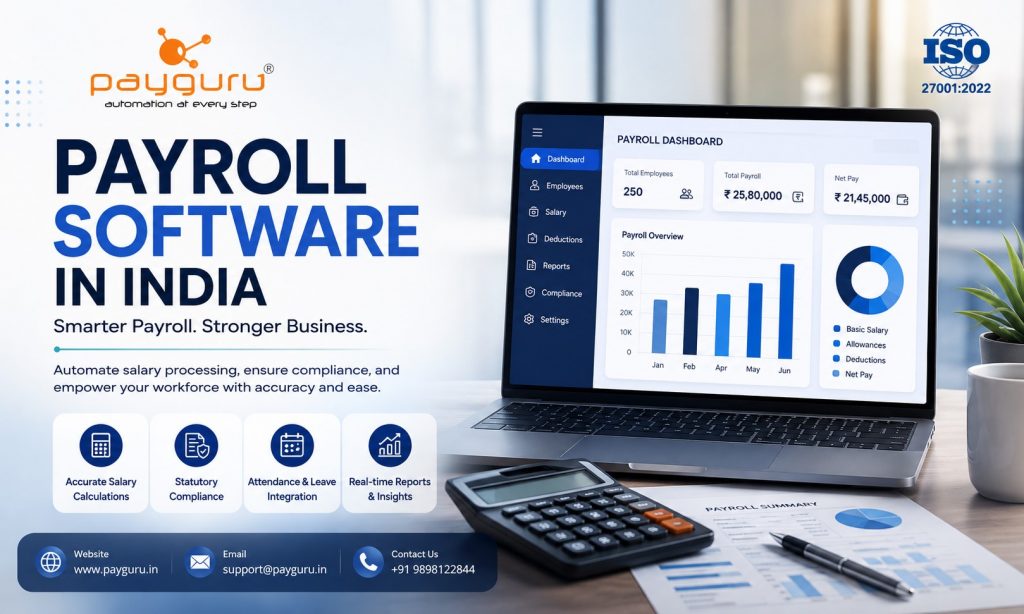
Payroll software in India is a digital solution that helps businesses calculate salaries, manage deductions, generate payslips, maintain payroll records, and support statutory compliance. Instead of relying on spreadsheets and repetitive manual calculations, organizations can use payroll software to centralize employee data and automate recurring payroll tasks.
For Indian businesses, payroll management can involve salary structures, attendance, leave, overtime, reimbursements, loans, advances, tax deductions, and statutory requirements such as Provident Fund, Employees’ State Insurance, Professional Tax, Tax Deducted at Source, gratuity, and other applicable obligations. The right payroll system connects these processes so payroll teams can work with consistent employee data and a defined approval workflow.
This guide explains the key features, benefits, practical use cases, challenges, and selection criteria for payroll software in India. It also highlights how payroll can work alongside HRMS software, attendance systems, and workforce management systems to create a more connected HR operation.
Payroll software is a business application that automates and manages the process of paying employees. It uses employee information, salary structures, attendance, leave, overtime, deductions, reimbursements, and other payroll inputs to calculate payable salaries and produce payroll outputs.
A typical payroll processing system workflow includes:
The exact capabilities vary by product, so businesses should evaluate whether a payroll management software system matches their workforce structure, policies, locations, and compliance requirements.
Payroll software in India is both an operational and employee-facing process. A small data error can affect an employee’s salary, deductions, payslip, or tax records. Manual processing also becomes harder when a business has multiple departments, locations, shifts, salary structures, or categories of workers.
A payroll automation system helps create a standardized process. Instead of calculating every salary manually, payroll teams can configure rules and reuse them for recurring payroll cycles. When payroll is integrated with attendance and leave data, the system can also reduce the need to transfer information between separate files or applications.
For example, if an employee’s approved leave, overtime, or attendance information is maintained in an integrated system, payroll software can use that information as an input rather than requiring HR staff to reconcile multiple spreadsheets.
Businesses can also combine payroll with broader HRMS and payroll software capabilities. PayGURU, for example, provides payroll functionality alongside HR and workforce management solutions. Its payroll management system includes salary processing, payslip generation, employee self-service, reporting, and support for several statutory compliance areas. Learn more about payroll management software from PayGURU
The core function of payroll software is accurate salary calculation based on configured rules. A system can handle fixed salary components and variable inputs such as overtime, incentives, reimbursements, deductions, loans, and advances.
Rule-based processing is particularly useful when employees have different salary structures or eligibility conditions in a payroll management system.
Indian organizations may have different salary components for different employee categories, grades, locations, or roles. Payroll software in India should allow authorized users to configure salary components and rules without rebuilding the entire payroll process.
A flexible payroll system can make it easier to manage revisions, allowances, deductions, and other recurring components.
Payroll management software can help businesses organize and automate compliance-related calculations, records, forms, and reports. Depending on the software and applicable regulations, this may include PF, ESI, Professional Tax, TDS, gratuity, Labour Welfare Fund, bonus, and other statutory requirements.
However, software does not transfer legal responsibility away from the employer. Businesses should keep configurations updated and obtain professional advice when regulations or employee circumstances require it.
Payroll software accuracy depends heavily on reliable attendance and leave data. Integration with time and attendance systems can help payroll teams use approved working hours, leave, shifts, overtime, late attendance, and related inputs.
This is especially important for organizations with shift-based or location-based workforces. PayGURU also provides time and attendance and payroll management system solutions as part of its workforce management offering. Explore PayGURU’s HR and workforce management solutions
Employee self-service in HRMS and payroll software allows employees to access information without depending on HR for every routine request. Depending on the system, employees may be able to view or download payslips, check attendance, apply for leave, submit tax documents, request time corrections, or review loan information.
This improves transparency while reducing repetitive HR queries.
A payroll processing system should generate clear payslips showing relevant salary components, deductions, and net pay. It may also provide salary registers, attendance reports, loan statements, tax-related reports, and other payroll documents.
Digital document generation helps organizations maintain consistent records and makes payroll management information easier to retrieve.
Payroll software in India can provide reports for HR, finance, management, and audit purposes. Useful reports may cover salary costs, employee deductions, attendance, overtime, department-wise payroll, statutory information, and payroll history.
Configurable reporting becomes more valuable when businesses operate across multiple departments or locations in a payroll management system.
Payroll software contains sensitive employee information, so access should be controlled according to job responsibilities. Role-based permissions can restrict who can view, edit, approve, or export specific information.
Businesses should also evaluate authentication, audit trails, backups, data retention, hosting practices, and vendor security controls before selecting a payroll system.
Payroll software in India rarely operates in isolation. Integration with HRMS, attendance systems, accounting platforms, banking workflows, or enterprise applications can reduce duplicate data entry.
PayGURU states that its payroll management software supports integration with systems such as SAP, Workday, and Tally, along with industry-standard integration methods.
Automation in a payroll automation system can reduce repetitive calculations and manual data consolidation.
A payroll management system reduces common manual errors by using configured rules and structured data inputs.
Payroll software reduces HR workload by automating salary calculations, payslips, and reports.
Employees using HRMS and payroll software can access payslips, attendance, and leave data anytime.
A payroll system helps standardize statutory calculations and reporting workflows.
Payroll software in India provides insights into workforce costs and trends when integrated with HR data.
A structured payroll management system supports business growth across teams, locations, and employee categories.
Manual payroll can work for very small teams, but payroll software becomes essential as complexity increases. Spreadsheet-based payroll management often leads to errors, version issues, and manual effort.
A payroll processing system ensures consistency, automation, and controlled workflows.
Evaluate:
Payroll software in India is essential for modern businesses to ensure accuracy, compliance, and efficiency. A well-designed payroll management system reduces manual effort, improves transparency, and supports business growth.
Businesses should choose a payroll software solution that aligns with their structure, compliance needs, and integration requirements.