Managing payroll is one of the most important responsibilities for any organization. Employees expect accurate and timely salary
 By Pay GURU
June 15, 2026
By Pay GURU
June 15, 2026
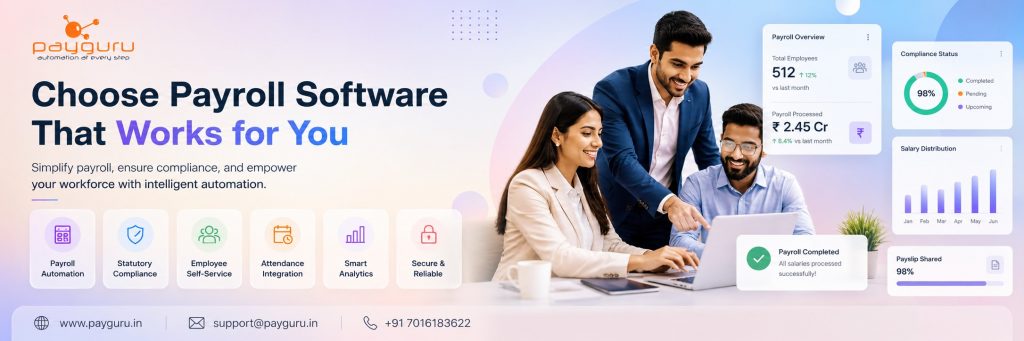
Managing payroll is one of the most important responsibilities for any organization. Employees expect accurate and timely salary payments, while businesses must comply with various labor laws, tax regulations, and statutory requirements. As companies grow, manual payroll processing becomes increasingly complex, time-consuming, and prone to errors.
This is where payroll software becomes essential. A reliable payroll solution can automate salary calculations, manage compliance, reduce administrative workload, and improve overall operational efficiency. However, with numerous options available in the market, selecting the right payroll software can be challenging.
This guide explains the key factors businesses should consider when choosing payroll software that aligns with their operational needs and future growth plans.
Payroll is more than simply calculating employee salaries. It involves attendance tracking, leave management, tax deductions, reimbursements, statutory compliance, reporting, and record keeping.
Modern payroll software helps organizations:
The right payroll system can help businesses focus more on growth and less on administrative tasks.
Before evaluating payroll software solutions, identify your organization’s specific needs.
Consider questions such as:
A clear understanding of your requirements helps narrow down the options and prevents unnecessary spending on features you may never use.
Automation is one of the biggest advantages of modern payroll software.
A good payroll system should automatically handle:
The software should calculate:
Automation minimizes human intervention and improves accuracy throughout the payroll cycle.
Employees should be able to receive or access digital payslips without requiring manual processing by HR teams.
The system should automate repetitive payroll tasks, reducing administrative effort and ensuring timely salary processing.
Compliance is a critical factor when selecting payroll software.
Businesses must adhere to various statutory regulations, including:
A robust payroll solution should automatically calculate statutory deductions, generate compliance reports, and help businesses stay aligned with changing regulations. This reduces compliance risks and simplifies audit preparation.
Payroll accuracy depends heavily on attendance and leave data.
Choosing software that integrates attendance management with payroll can significantly reduce manual work and payroll discrepancies.
Key features to look for include:
Integrated attendance and payroll systems ensure salary calculations are based on accurate workforce data.
Employee self-service (ESS) has become a valuable component of modern payroll systems.
An ESS portal allows employees to:
Self-service functionality reduces HR workload while improving employee experience and transparency.
Payroll data provides valuable insights for decision-making.
The software should offer comprehensive reporting tools such as:
Customizable reports help business leaders gain better visibility into workforce costs and operational efficiency.
Your payroll software should support your business not only today but also in the future.
As your organization grows, the system should be able to handle:
Scalable software eliminates the need for frequent system replacements and ensures long-term value.
Payroll software should work seamlessly with other business systems.
Important integrations may include:
Integrated systems improve data consistency and eliminate duplicate data entry.
Payroll data contains highly sensitive employee and financial information.
Before selecting a solution, evaluate its security measures.
Look for:
Strong security safeguards protect both employee information and organizational data.
Even the most feature-rich payroll software can become a burden if it is difficult to use.
Choose a platform with:
Ease of use improves adoption across HR, finance, managers, and employees.
Technology alone is not enough. Reliable customer support is equally important.
Evaluate:
A dependable vendor ensures smooth payroll operations and faster issue resolution when challenges arise.
Cost should always be evaluated alongside functionality.
Instead of focusing solely on the lowest price, assess:
A slightly higher investment in the right solution often delivers better long-term value through efficiency and reduced administrative workload.
Choosing the right payroll software is a strategic decision that impacts employee satisfaction, compliance management, operational efficiency, and business growth. The ideal solution should automate payroll processes, ensure statutory compliance, integrate with attendance and HR systems, provide employee self-service capabilities, and scale alongside your organization.
By carefully evaluating your business requirements and focusing on functionality, security, compliance, and usability, you can select a payroll platform that simplifies workforce management while supporting long-term success.
Ready to streamline payroll processing, improve compliance, and automate workforce management? Explore professional payroll solutions from PayGURU Payroll Software and discover how modern payroll automation can help your business operate more efficiently.