Starting and scaling a business comes with numerous challenges, and managing employees is one of the most important. As startups
 By Pay GURU
June 12, 2026
By Pay GURU
June 12, 2026
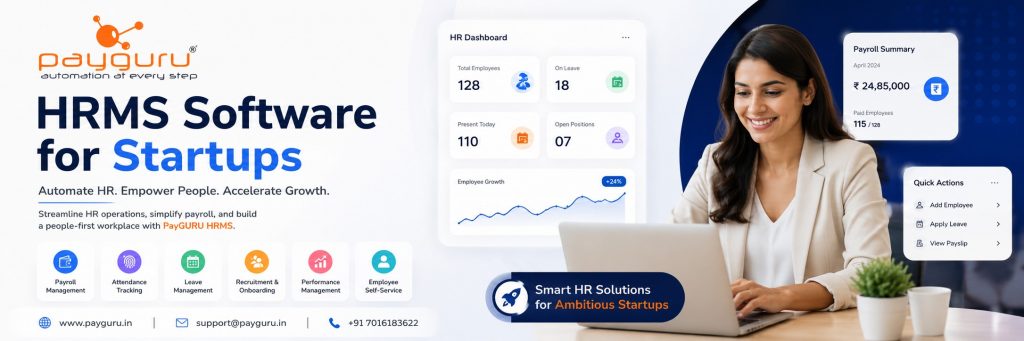
Starting and scaling a business comes with numerous challenges, and managing employees is one of the most important. As startups grow, handling recruitment, attendance, payroll, leave management, compliance, and employee records manually can become time-consuming and prone to errors. This is where HRMS software for startups plays a critical role.
A Human Resource Management System (HRMS) helps startups automate HR operations, improve efficiency, and create a better employee experience. By centralizing HR processes into a single platform, startups can focus more on growth and innovation rather than administrative tasks.
In this article, we’ll explore what HRMS software is, why startups need it, its key features, benefits, and how to choose the right solution.
HRMS (Human Resource Management System) software is a digital platform designed to manage and automate various human resource functions. It serves as a centralized system that stores employee information and streamlines everyday HR tasks.
An HRMS typically combines multiple functions, including:
For startups, an HRMS provides structure and organization without requiring a large HR team.
Many startups begin by managing HR activities using spreadsheets, emails, and manual processes. While this approach may work initially, it becomes increasingly difficult as the workforce expands.
Common HR challenges faced by startups include:
An HRMS software solution addresses these challenges by automating repetitive tasks and improving operational efficiency.
An HRMS stores employee data in a secure centralized database. HR teams can easily access information such as:
This eliminates the need for multiple spreadsheets and scattered records.
Accurate attendance tracking is essential for payroll and workforce management.
Modern HRMS platforms allow businesses to:
Automated attendance management reduces manual errors and saves time.
Managing employee leave requests manually can create confusion and delays.
HRMS software enables employees to:
Managers can review and approve requests quickly, improving transparency across the organization.
Payroll is one of the most critical HR functions.
An HRMS can automate:
Automated payroll processing helps startups ensure accuracy and timely salary payments.
Hiring the right talent is essential for startup success.
HRMS software supports recruitment by helping organizations:
Once a candidate is selected, onboarding processes can also be streamlined through digital documentation and automated workflows.
Self-service functionality empowers employees to access information independently.
Employees can:
This reduces HR workload while improving employee satisfaction.
Tracking employee performance becomes increasingly important as startups scale.
HRMS solutions often include tools for:
These features help organizations build a high-performing workforce.
Automation eliminates repetitive manual tasks, allowing HR teams to focus on strategic initiatives such as employee engagement and talent development.
Manual data entry often leads to mistakes. HRMS software reduces errors in payroll, attendance, and employee records.
Startups must comply with labor laws, tax regulations, and statutory requirements.
HRMS software helps maintain accurate records and supports compliance-related reporting, reducing administrative risks.
Employees appreciate quick access to information and streamlined processes.
Features such as self-service portals, digital leave requests, and online payslips contribute to a positive workplace experience.
An HRMS generates valuable workforce insights through reports and analytics.
Management can use these insights to:
As startups grow, HR requirements become more complex.
A robust HRMS can scale alongside the business, supporting additional employees, locations, and processes without major disruptions.
Selecting the right HRMS requires careful evaluation of business needs and future growth plans.
Start by understanding which HR processes need improvement.
Consider areas such as:
Choosing software aligned with your priorities ensures better adoption and value.
A complicated system can slow down implementation and reduce employee adoption.
Choose an HRMS with:
User-friendly software improves productivity from day one.
Your startup may grow rapidly in the coming years.
Select an HRMS that can accommodate:
Scalable solutions prevent the need for frequent system changes.
The HRMS should integrate smoothly with other business systems such as:
Seamless integration improves data accuracy and operational efficiency.
Employee information is highly sensitive.
Look for HRMS software that offers:
Strong security measures help protect employee and company information.
Reliable support can significantly impact implementation and ongoing usage.
Choose a vendor that provides:
Good support ensures smooth operations and faster issue resolution.
When implementing HRMS software, startups should avoid:
Careful planning can maximize the return on investment and ensure successful adoption.
As workplaces continue to evolve, HR technology is becoming increasingly important. Cloud-based HRMS solutions, mobile access, automation, and advanced analytics are helping startups manage their workforce more effectively.
Businesses that adopt modern HRMS software early can build stronger HR foundations, improve employee experiences, and support sustainable growth.
Managing human resources efficiently is crucial for every startup. As organizations expand, manual HR processes become difficult to manage and can hinder productivity. HRMS software simplifies workforce management by automating payroll, attendance, leave tracking, recruitment, onboarding, and performance management.
By choosing the right HRMS solution, startups can improve efficiency, ensure compliance, enhance employee satisfaction, and prepare for future growth. Investing in a reliable HRMS is not just an operational decision—it is a strategic step toward building a scalable and successful business.
Ready to streamline your HR operations? Explore the comprehensive HRMS solutions offered by PayGURU HRMS and discover how automation can help your startup grow with confidence.