Managing human resources manually becomes increasingly difficult as an organization grows. Employee records, attendance, leave
 By Pay GURU
September 09, 2026
By Pay GURU
September 09, 2026
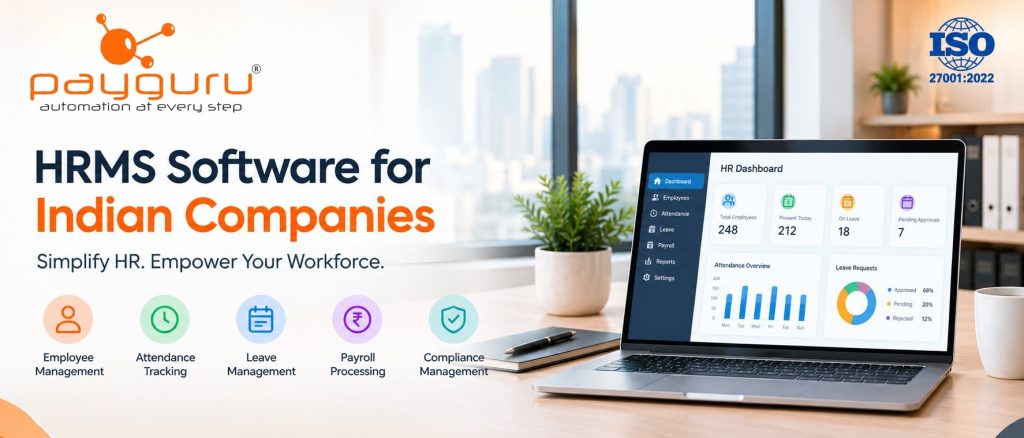
Managing human resources manually becomes increasingly difficult as an organization grows. Employee records, attendance, leave requests, payroll inputs, compliance documents, approvals, and reports can quickly become scattered across spreadsheets, emails, paper files, and disconnected systems. HRMS software for Indian companies provides a centralized way to manage these activities while improving process consistency, visibility, and administrative efficiency.
An HRMS, or Human Resource Management System, brings multiple HR functions into a single digital platform. Depending on the solution, it can support employee management, attendance tracking, leave management, payroll, compliance, employee self-service, document management, workflows, and HR reporting. For Indian businesses, an HRMS can be particularly useful where organizations need to manage multiple locations, shifts, employee categories, statutory requirements, and growing workforce data.
The value of HRMS software is not simply about replacing paperwork with software. A well-configured system can connect HR processes, reduce repetitive administrative work, provide better workforce visibility, and help management make decisions using reliable employee data.
HRMS software is a centralized digital system used to manage employee information and core human resource processes.
Instead of maintaining separate spreadsheets for employee details, attendance registers for working hours, emails for leave approvals, and separate files for HR documents, an HR management system brings these processes together.
Typical HRMS capabilities include:
The exact functionality varies by software, so businesses should evaluate features according to their workforce structure and operational requirements.
Indian businesses operate in a diverse employment environment. Organizations may have permanent employees, contract workers, multiple branches, different shifts, location-specific policies, and varying payroll requirements.
As workforce size increases, manual HR processes can create problems such as duplicate records, delayed approvals, attendance discrepancies, payroll input errors, and difficulty retrieving documents.
An HRMS for Indian businesses can create a more structured environment by connecting employee information with attendance, leave, payroll, workflows, reporting, and compliance processes. PayGURU, for example, provides HRMS functionality covering employee lifecycle management, attendance, leave, workflows, compliance, reporting, and payroll readiness.
One of the most important HRMS benefits is the ability to maintain employee information in a centralized system.
HR teams can manage employee profiles, departments, job roles, salary-related information, documents, attendance history, leave records, and other workforce information from one platform.
This reduces the need to search through multiple spreadsheets and physical files whenever employee information is required.
A centralized employee database management system can also improve consistency because authorized users work with the same underlying information.
For companies operating across several departments or locations, centralized information can make HR administration easier to control and monitor.
Attendance is closely connected with payroll, leave, overtime, shift management, and workforce planning.
Manual attendance processes can make it difficult to reconcile working hours, missing punches, late arrivals, absences, and overtime.
Modern attendance management software can integrate with biometric devices, RFID systems, face recognition devices, mobile attendance, or other approved attendance methods. Attendance data can then be synchronized with the HRMS for further processing.
This can help HR teams:
For businesses with large or distributed workforces, automated attendance can significantly simplify day-to-day administration.
Managing leave through emails, spreadsheets, or paper forms can make it difficult to maintain accurate leave balances and approval records.
A leave management system allows employees to submit requests digitally while managers and HR teams can review them through configured workflows.
Depending on the system, employees may be able to check available leave, submit applications, view approval status, and access holiday information. HR teams can maintain centralized leave records and monitor workforce availability.
For managers, this provides greater visibility when planning staffing and approving leave.
Payroll depends on accurate employee information and timely inputs from several HR processes.
Attendance, leave, overtime, salary structures, deductions, reimbursements, and statutory requirements can all influence payroll calculations.
An integrated payroll management system can connect relevant HR data and automate several payroll activities. PayGURU’s payroll platform, for example, supports configurable salary structures, statutory components such as PF, ESIC, Professional Tax and other requirements, along with employee self-service capabilities.
The benefit is not simply automation. Connecting HR and payroll data can reduce duplicate data entry and make it easier to trace information used in payroll processing.
Employees frequently need access to basic HR information such as payslips, attendance records, leave balances, tax documents, or shift schedules.
An employee self-service portal allows employees to handle many routine requests without contacting HR for every transaction.
Depending on configuration, employees can:
This can reduce routine HR queries while giving employees greater visibility into their own HR information.
Compliance is a critical consideration for Indian businesses. HR teams may need to manage information and processes associated with areas such as PF, ESI, Professional Tax, TDS, labour requirements, employee documentation, and statutory reporting, depending on the organization and applicable regulations.
An HRMS can help organize compliance-related information, configure relevant workflows, generate reports, and create reminders for important documents or expiry dates.
For example, an HRMS may support alerts for contract expiry, licenses, insurance documents, or other compliance-related requirements.
However, businesses should not assume that software alone guarantees compliance. HR and legal teams should ensure that system configurations reflect current applicable laws, company policies, and regulatory requirements.
Many HR activities require multiple levels of approval.
Examples include:
With HR workflow automation, requests can be routed to the appropriate manager, HR user, or department according to predefined rules.
This creates a clearer process than relying entirely on email chains or physical forms. It can also provide an audit trail showing the status of a request and the relevant approval steps.
HR teams need accurate information to understand workforce patterns and support management decisions.
An HRMS can bring together information from different HR processes and present it through reports and dashboards.
Useful HR analytics and reporting may include:
PayGURU’s HRMS supports daily and monthly reporting, workforce reports, dashboards, and exports in formats such as Excel, PDF, Word, and ODBC.
The quality of these insights depends on the accuracy and completeness of the underlying data, which makes proper HRMS implementation important.
HR teams often spend considerable time handling repetitive administrative requests.
An HR automation system can automate or streamline activities such as attendance processing, leave workflows, employee information management, report generation, and employee self-service.
This does not mean automation replaces HR professionals. Instead, it can reduce the administrative burden and allow HR teams to spend more time on activities such as workforce planning, employee development, engagement, recruitment, and organizational improvement.
An HR process that works for 50 employees may become difficult to manage at 500 or 5,000 employees.
As organizations expand, they may add new departments, branches, locations, shifts, employee categories, and approval structures.
A scalable HRMS software solution can provide a centralized framework that grows with the organization.
Multi-company and multi-location capabilities can be particularly useful for businesses operating across different sites or organizational units. PayGURU’s HRMS supports multi-company and multi-location workforce management.
The biggest difference between manual HR management and an HRMS is how information and processes are handled.
In a manual setup, employee information may be distributed across spreadsheets, emails, registers, and individual files. HR employees often have to collect information from different sources before completing a task.
With HRMS automation, information can be centralized and connected. An attendance record can feed into leave and payroll processes, while an employee can submit a request through self-service and have it routed through an approval workflow.
Manual processes may still be appropriate for very small organizations with limited HR activity. However, as workforce complexity increases, an integrated HRMS can provide greater consistency, visibility, and process control.
Different organizations can use HRMS software in different ways.
Manufacturing organizations often manage multiple shifts, shop-floor employees, biometric attendance, overtime, contract workers, and compliance requirements.
An HRMS can connect attendance management, shift management, employee records, payroll inputs, and workforce reporting.
Service businesses may place greater emphasis on employee self-service, leave management, payroll, documents, approvals, and centralized employee information.
A digital HRMS can help employees access routine HR services without repeatedly contacting HR teams.
Organizations with branches in different cities can use centralized HR management software to maintain consistent processes while giving authorized users access to location-specific information.
Organizations that rely on contractors may need additional controls around worker records, documentation, licenses, insurance, attendance, and compliance.
An HRMS or workforce management platform with appropriate contract labour capabilities can help centralize this information and create clearer controls.
Before selecting an HRMS software in India, businesses should evaluate more than the number of features.
Important considerations include:
Buying HR software is only the first step. Successful implementation requires planning.
Identify current HR challenges before selecting modules. Determine which processes create the most administrative workload or data inconsistencies.
Before migration, review employee records and remove duplicate, outdated, or incomplete information.
Approval structures should reflect actual company policies and reporting relationships.
Users should understand how to complete routine activities within the system. Training can reduce resistance and improve adoption.
Business requirements change over time. Periodically review workflows, reports, access permissions, attendance rules, and compliance-related configurations.
The best HRMS for Indian companies is not necessarily the platform with the longest feature list. It is the system that fits the organization’s workforce structure, processes, budget, compliance requirements, and growth plans.
Before making a decision, businesses should assess:
A practical approach is to shortlist systems based on business requirements and then request a product demonstration using real-world HR scenarios.
The main benefits include HR automation, centralized employee data, attendance management, leave tracking, payroll integration, employee self-service, workflow automation, reporting, and improved workforce visibility. The exact benefits depend on the organization’s requirements and the modules implemented.
Yes. Small businesses can use HRMS software to organize employee records, attendance, leave, payroll, and routine HR processes. However, they should select a solution that matches their current workforce size and can scale as the company grows.
An integrated HRMS and payroll system can use information such as employee details, attendance, leave, overtime, salary structures, and applicable deductions as inputs for payroll processing. This can reduce duplicate data entry and streamline payroll workflows.
Many HRMS platforms can integrate with biometric attendance devices. Depending on the solution, integrations may support fingerprint, face recognition, RFID, or other attendance technologies. Businesses should confirm device compatibility before implementation.
HRMS can support compliance-related processes by organizing employee data, configuring relevant rules, generating reports, and providing alerts or documentation workflows. However, businesses remain responsible for ensuring that their processes and system configurations comply with applicable laws and regulations.
Employee self-service, or ESS, allows employees to access selected HR services directly. These may include leave applications, attendance information, payslips, document access, personal information updates, and attendance correction requests.
Companies should consider features, integration, scalability, security, compliance support, ease of use, reporting, customization, implementation, training, and technical support. The software should be evaluated against actual HR workflows rather than features alone.
For Indian companies, effective HR management requires more than maintaining employee records. As organizations grow, connected processes become increasingly important for managing attendance, leave, payroll, compliance, employee requests, documentation, and workforce information.
The right HRMS software can provide a centralized foundation for these activities while reducing repetitive administrative work and improving visibility across HR operations. Its real value comes from connecting processes that are often managed separately.
Businesses should therefore approach HRMS selection as an operational decision, not simply a software purchase. Evaluate your workforce structure, identify process gaps, verify integration and compliance requirements, and choose a system that can support both current needs and future growth.
If your organization is looking to streamline employee management, attendance, payroll, leave, compliance, and workforce operations, explore PayGURU’s HRMS solutions and learn how an integrated HR platform can support more efficient HR management.
Explore your HRMS requirements and speak with the PayGURU team through Contact Us.