Introduction Managing employees efficiently has become a priority for organizations of every size. As businesses grow, handling
 By Pay GURU
August 24, 2026
By Pay GURU
August 24, 2026
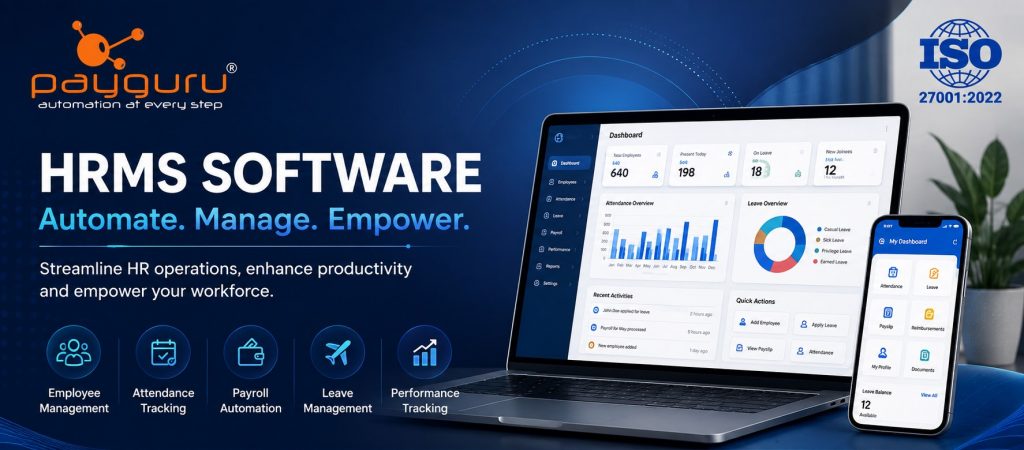
Managing employees efficiently has become a priority for organizations of every size. As businesses grow, handling recruitment, attendance, payroll, leave, performance, compliance, and employee records manually becomes increasingly time consuming and prone to errors. This is where HRMS Software plays a critical role.
HRMS Software automates routine human resource processes, allowing HR teams to focus on strategic initiatives instead of repetitive administrative tasks. From onboarding new employees to processing salaries and generating compliance reports, an integrated Human Resource Management System (HRMS) simplifies workforce management while improving accuracy and employee satisfaction.
Whether you operate a small business or a large enterprise, adopting HRMS Software helps streamline operations, reduce paperwork, improve compliance, and provide employees with self service capabilities. This article explains how HRMS Software automates employee management, explores its key features, benefits, use cases, best practices, and why it has become an essential business solution.
HRMS Software, also known as a Human Resource Management System, is a centralized digital platform that automates and manages various HR functions throughout the employee lifecycle.
Instead of maintaining multiple spreadsheets or disconnected systems, HR professionals can access employee information, attendance records, payroll data, leave requests, and performance reports from one secure platform.
Common modules include:
Businesses looking for a complete solution can explore PayGURU’s HRMS Software platform for integrated workforce management.
Traditional HR processes involve repetitive manual work that consumes valuable time.
Examples include:
With HRMS Software, these activities become automated, reducing human intervention while increasing operational efficiency.
Hiring is only the beginning. New employees require multiple administrative tasks before they become productive.
An automated onboarding process can:
This reduces paperwork while creating a smooth experience for new hires.
One of the biggest advantages of HRMS Software is maintaining a single source of truth.
Employee records may include:
Authorized users can access updated information instantly without searching through physical files.
Tracking attendance manually often leads to inaccuracies and disputes.
Modern Attendance Management Software automatically records:
Integration with biometric devices, mobile applications, and facial recognition systems further improves accuracy. Learn more about automated Time and Attendance Software solutions.
Leave requests no longer require paperwork or email chains.
Employees can:
Managers can:
Automatic leave balance calculations eliminate manual tracking.
Payroll is one of the most complex HR responsibilities.
A reliable Payroll Software automates:
Automation significantly reduces payroll errors while ensuring timely salary processing. Discover PayGURU’s Payroll Software for seamless payroll management.
An Employee Self Service (ESS) portal empowers employees to manage routine HR activities independently.
Employees can:
This reduces HR workload while improving employee satisfaction.
Performance evaluations become more transparent and data driven.
HRMS platforms help automate:
Managers receive real time insights instead of relying solely on annual reviews.
Maintaining compliance is essential for avoiding penalties.
HRMS Software helps automate compliance by:
Automation reduces compliance risks while ensuring documentation remains up to date.
Many HRMS solutions include Applicant Tracking System features.
Automation includes:
This accelerates hiring while improving the candidate experience.
Manual report preparation can take hours.
HRMS generates reports instantly for:
These insights support better business decisions.
Consider a company with 500 employees.
Without HRMS Software:
With HRMS Software:
The difference is improved efficiency, better employee experience, and reduced manual work.
Organizations adopting HRMS Software experience several operational advantages.
Automation minimizes manual data entry and calculation errors.
Routine HR activities are completed faster through automated workflows.
Self service portals provide employees with quick access to HR services.
Automated statutory calculations reduce compliance risks.
Real time dashboards help management make informed workforce decisions.
Role based access protects sensitive employee information.
Businesses can manage growing workforces without proportionally increasing HR administrative effort.
Businesses often compare automated HR systems with traditional methods.
Manual HR management depends heavily on spreadsheets, paperwork, and repetitive tasks. It requires significant human effort, increases the risk of errors, and makes reporting slower.
In contrast, HRMS Software centralizes employee information, automates calculations, simplifies approvals, improves compliance, and provides instant reports. As organizations grow, automation becomes more sustainable than manual administration.
Almost every industry benefits from HR automation, including:
Organizations with distributed workforces especially benefit from centralized employee management.
While automation offers significant benefits, businesses should plan implementation carefully.
Potential challenges include:
Selecting the right implementation partner and providing proper training can minimize these challenges.
To maximize the value of HRMS Software, businesses should:
HR technology continues to evolve with advanced capabilities such as:
These innovations are helping organizations build more agile and employee centric workplaces.
HRMS Software is a digital platform that automates HR processes such as employee records, attendance, payroll, leave, recruitment, performance, and compliance.
It automates repetitive HR tasks, centralizes employee information, reduces manual errors, improves communication, and enables faster decision making.
Yes. Many HRMS solutions are designed for businesses of all sizes and can scale as organizations grow.
Most modern HRMS platforms integrate directly with Payroll Software, allowing attendance, leave, and salary calculations to work together automatically.
Yes. HRMS helps maintain employee records, statutory calculations, reporting, and audit trails, making compliance management easier.
An Employee Self Service portal allows employees to access payslips, attendance, leave balances, tax documents, and personal information without contacting HR.
Implementation timelines depend on company size, data migration requirements, integrations, and customization. Many organizations complete implementation within a few weeks to a few months.
HRMS Software has transformed the way organizations manage their workforce by automating repetitive HR processes, improving operational efficiency, and delivering a better employee experience. From onboarding and attendance tracking to payroll processing and compliance management, automation enables HR professionals to focus on strategic initiatives that drive business growth.
As businesses continue to embrace digital transformation, investing in a reliable Human Resource Management System is no longer just an operational improvement. It is a strategic decision that supports scalability, compliance, and long term workforce success.
Ready to simplify your HR operations with a powerful HRMS Software solution?
Explore PayGURU’s complete suite of HR and payroll solutions today and discover how automation can improve employee management, compliance, and productivity.