Managing employees manually is no longer practical for modern businesses. From attendance tracking and payroll processing to
 By Pay GURU
May 23, 2026
By Pay GURU
May 23, 2026
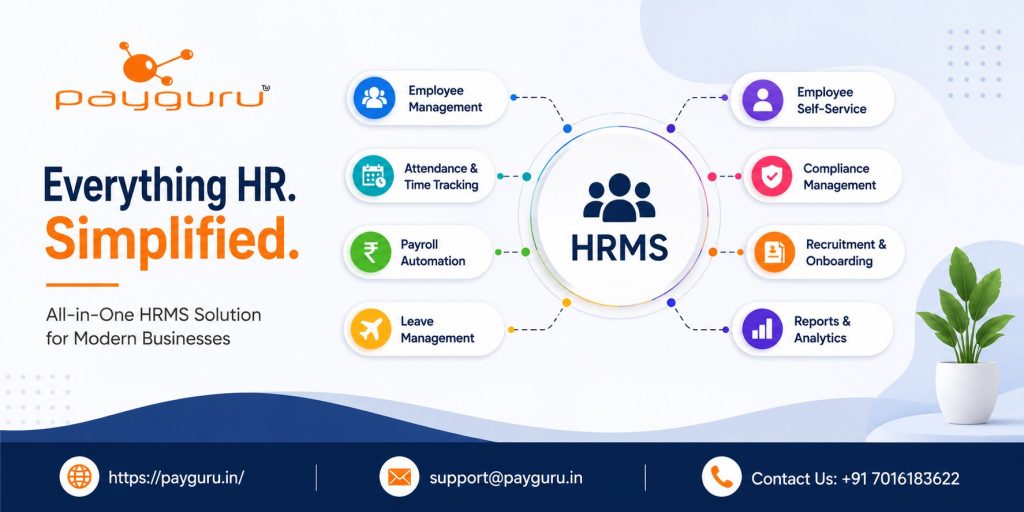
Managing employees manually is no longer practical for modern businesses. From attendance tracking and payroll processing to compliance management and employee engagement, companies need a smarter way to handle HR operations. This is where an HRMS (Human Resource Management System) becomes essential.
A good HRMS software helps businesses automate routine HR tasks, reduce errors, improve productivity, and create a better employee experience. Modern HRMS platforms also support remote work, real-time reporting, and seamless workforce management.
If you are planning to invest in HR software, here are the top features every HRMS software should have.
One of the most important features of HRMS software is centralized employee data management. Instead of storing information across spreadsheets and files, HR teams can maintain everything in one secure platform.
This includes:
A centralized database improves accuracy, saves time, and allows HR teams to access employee information instantly whenever required.
Manual attendance systems often lead to errors, buddy punching, and payroll mismatches. A modern HRMS should provide automated attendance management integrated with biometric devices, face recognition systems, mobile apps, or GPS tracking.
Key attendance features should include:
Automated attendance management helps organizations improve workforce discipline while ensuring payroll accuracy.
Payroll processing is one of the most critical HR functions. A reliable HRMS software should automate salary calculations, deductions, bonuses, taxes, and payslip generation.
Essential payroll features include:
Payroll automation reduces manual work, minimizes salary errors, and ensures timely payments to employees.
A strong leave management module simplifies leave applications, approvals, and tracking.
The software should allow employees to:
Managers and HR teams should also be able to approve or reject requests instantly through automated workflows. This improves transparency and reduces administrative workload.
Employees today expect quick access to their HR information without depending on HR teams for every small request. That is why self-service portals have become one of the most valuable HRMS features.
An employee self-service portal should allow users to:
This feature improves employee experience while reducing HR workload significantly. Many HR professionals consider self-service portals one of the most underrated but highly useful HRMS features.
Compliance is a major challenge for businesses, especially in India where labor laws and statutory regulations frequently change.
A good HRMS software should help businesses stay compliant with:
Automated alerts and reminders for expiring documents, contracts, and licenses can help businesses avoid penalties and compliance risks.
Hiring and onboarding employees manually can be time-consuming and inefficient. Modern HRMS software should simplify the recruitment process from candidate application to onboarding.
Useful onboarding features include:
A smooth onboarding experience helps new employees become productive faster.
HR decisions become more effective when supported by accurate data. A modern HRMS should provide real-time dashboards and detailed reports for better workforce planning.
Important reports include:
Analytics help management make informed decisions and identify workforce trends easily.
With remote and hybrid work becoming common, employees and managers need access to HR services from anywhere.
Mobile HRMS access allows users to:
Mobile accessibility improves flexibility, especially for field staff and distributed teams.
HR data contains sensitive employee information, making security a top priority.
A reliable HRMS should provide:
These features help protect confidential data while ensuring only authorized users can access specific information.
As organizations grow, managing HR operations manually becomes difficult and error-prone. Businesses need HRMS software to improve efficiency, automate repetitive tasks, reduce compliance risks, and enhance employee satisfaction.
According to HR professionals and business users, the most valuable HRMS benefits include automation, payroll accuracy, centralized data management, attendance tracking, and employee self-service functionality.
An ideal HRMS solution should not only manage employees but also support long-term business growth through automation and intelligent workforce management.
Choosing the right HRMS software can transform the way your organization manages employees. From payroll automation and attendance tracking to compliance management and analytics, the right features can save time, improve accuracy, and increase productivity.
Businesses should always look for scalable, user-friendly, and automation-driven HRMS software that meets their operational needs while ensuring compliance and employee satisfaction.
If your organization still relies on spreadsheets or disconnected systems, upgrading to a smart HRMS platform can significantly improve HR efficiency and workforce management.
Looking for a smart and reliable HRMS solution for your business?
PayGURU HRMS helps businesses automate attendance, payroll, leave management, compliance, onboarding, and workforce operations through one powerful platform.
Simplify your HR processes, reduce manual work, and improve employee management with PayGURU today.
📞 Request a free demo and discover how PayGURU can streamline your HR operations.